

Fassett GreenSpace
Wellsville, Allegany County
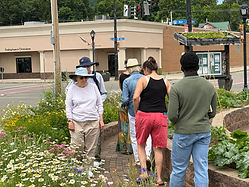
A public garden, sculpture park and outdoor meeting space, Fassett GreenSpace features 2,000 square feet of vegetables, flowers, and herbs that are completely free for the community to harvest. This Main Street corner has a long history as a community hub: the plot of land hosted community meetings and was later the location of Wellsville’s first tavern, Van Buren’s, where town leaders met to name the town after an early settler in the area, Gardiner Wells. The historic Fassett House Hotel, built on the site in 1870, had rooms for rent, retail space, a ballroom, offices, and a barber shop. For more than a century, before its demolition in 2005, it was a community “center” for local residents. Today, the Fassett GreenSpace operates as a critical third space in Wellsville.

The Spark
A vacant Main Street lot became an opportunity to create a shared garden and gathering place for Wellsville.


Andy Glanzman, a local businessman, purchased the Fassett House grounds after the hotel’s demolition. He wanted to repurpose the space into something the entire community could use, rather than see it become a parking lot or commercial space. However, he lacked the time and resources to develop the lot, and it sat empty for over a decade until he was approached by Wellsville native Andrew Harris in 2017.
Harris grew up when the Fassett House Hotel was still standing, getting haircuts at the barbershop there. A few years prior to reaching out to Glanzman, he had established Sunset Farms, an organic vegetable garden and farm rescue center, and wanted to encourage local food growing and help people gain access to fresh, healthy food. Glanzman agreed to let Harris maintain the plot and install planters.
The Project
The lot had no water supply, which made growing challenging, but school groups and community members still used it and tended to the plants. Enter Cassandra Bull, an Alfred University alumna with a degree in Art and Ecology who was working as an AmeriCorps Community Garden Coordinator. Recognizing the need for a garden and public gathering space in Wellsville, she connected with Glanzman and Harris, solidifying the idea of the GreenSpace.
Getting water to the site remained a primary concern. Bull attended village board meetings to advocate for the garden, but the Village of Wellsville would not provide water to a privately owned lot. Glanzman then suggested reviving a dormant nonprofit he had established years earlier, Art for Rural America (AFRA), which made the project eligible for municipal water access and funding. Glanzman leased the site to AFRA for $1 a year. Bull wrote the first grant application and received $22,000 to install a waterline and purchase materials such as soil. She began working with Nate Piscitelli, the grandson of the barber at the original Fassett House Hotel, and an architecture student at Alfred State, to create the site drawings.
Ground was broken in the Fall 2017 with site preparation by Alfred State’s heavy equipment program. Every day for two months, Bull laid permeable blocks alongside a crew of 20 volunteers. Using equipment donated by local businesses, they moved soil into new planters and received donations of starter plants from a local nursery.


Outcomes & Benefits
A community member had an idea for a Little Free Library in Wellsville in 2019 and brought it up to AFRA members, so they built the Little Free Library, painted by a local artist, on the GreenSpace.
The GreenSpace hosts unique events ranging from dance and cooking classes to after-school group trips, holiday light shows and story hours. In August 2021, for example, local dance instructor Kate Martelle choreographed a performance in which dancers moved between the GreenSpace’s labyrinth-like walls and interacted with the garden plants.
The bronze fountain at the center was constructed by Bill Underhill, a local sculptor and professor emeritus at Alfred University, who proposed the addition while casually walking by the lot. The bronze was cast at the Alfred University Foundry in 2018. The fountain has special significance to Harris, as it was one of the last pieces Underhill made before his death in 2022.
In 2019, the Wellsville Creative Arts Center, which Glanzman directs, hosted mosaic workshops, allowing community members to sculpt and glaze small ceramic tiles of fruits and vegetables, which were assembled by an artist to become a central part of an information kiosk (built by Bull’s partner) featuring solar panels and a living roof. The kiosk was unveiled at the official grand opening of the GreenSpace later that year. In a nod to its roots, the mosaic contains physical impressions of original keys from the Fassett House Hotel.
In 2019, Greenspace received funding to create sculptural musical instruments, designed by Harmony Freenotes Park. That same year, Dustin Woodard, local percussionist professor at Alfred University, received a grant from the Tri-county Arts Council to compose a GreenSpace theme song. Woodard and students played the composition – using the sculptural instruments – at the official opening celebration of the GreenSpace in August 2019.


Since its inception, the GreenSpace has been shaped by community collaboration, in which community feedback is sought after, and the space is adapted to meet the needs of local residents. Bull describes the modern GreenSpace as “quilted” due to the way its design and features developed incrementally over time, shaped by community input and supported through grants and donations from a variety of sources.
Partnerships & Funding
Initial funding from the Garman Family Foundation launched the construction of the GreenSpace, which has since been sustained by diverse financial contributions, municipal support, and active community collaborations. Capital and programming development were driven by $110,000 in grant funding received between 2017 and 2022—with individual grants ranging from $500 to over $32,000—alongside a $5,000 donation from the Players of Alleghany County theatre troupe upon their disbandment. Key infrastructure and operational partnerships include the Ralph C. Wilson Jr. Foundation and KABOOM!, who collaborated to provide sculptural musical instruments, and the Village of Wellsville, which agreed to provide free water to the site. The physical creation of the GreenSpace relied heavily on professional and student volunteer labor, including consulting and construction services from Clark Patterson Lee Architects and LC Whitford & Co. Construction, alongside build volunteers from Alfred University and Alfred State College.

Lessons Learned
LESSON 1
Honoring historic connections can deepen community identity and support for placemaking projects, as seen in the homage to the Fassett House Hotel in the mosaic on the information board.
LESSON 2
Community revitalization projects can provide important learning opportunities for young leaders. For Bull, creating the GreenSpace gave her experience in grant writing and community organizing.

LESSON 3
Design can be used to modify how people use a space. The GreenSpace faced issues with loiterers, which discouraged others from using the space and eventually shifted to adapting the space to re-focus priority uses.

The Fassett GreenSpace, as a free, accessible community space that provides fresh produce, art, and a gathering place for residents, reflects the resilience of rural communities and demonstrates how collective effort, no matter how small an individual contribution, can have a big impact. Community-driven placemaking can strengthen local identity and pride, support social and civic life and create meaningful public space in a region facing long‑term economic challenges.