


Palmer Opera House
12 West Main St, Cuba
Originally built in 1867 by local businessman Joseph Palmer, the Palmer Opera House has served as a center of commercial and community life in Cuba for more than 150 years. After the original structure was destroyed by fire in 1871, Palmer rebuilt the venue, which went on to host decades of theater, vaudeville, social gatherings, and other community events. Today, the restored Palmer Opera House anchors a row of Main Street storefronts and continues that tradition as a welcoming place that preserves local history and provides community entertainment. Its second-floor auditorium hosts live performances, open mic nights, classes, and community gatherings, while the first floor is home to local businesses and the Cuba Cheese Museum, celebrating the area’s longstanding dairy heritage.

The Spark
When storm damage pushed the Palmer Opera House toward demolition, a group of residents organized to save it.
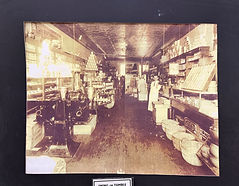

Following World War II, the shops on the building's first floor continued to be occupied, but the second floor ceased to be used for events. As the population of Cuba declined in the 90s, so did activity on Main Street, and the Palmer Opera House eventually was abandoned in the 90s after Carpenter's Department store moved out. Heavy storms in the winter of 2002 knocked a roof beam through the structure, leaving the entire upper floor exposed. For the next three years, the Palmer Opera House remained in a state of disrepair. Some residents wanted the building demolished – at a cost of more than $100,000 – and the land repurposed for a new use, like a parking lot. Others, however, had a different idea.
Three years after the roof fell in, a group of residents met to save the Palmer Opera House. They called themselves the Cuba Friends of Architecture (CFA). They doubted the building could survive another winter, so later that year, when the property’s owner decided to sell the abandoned building, CFA acted quickly. The group had not yet received official non-profit status, so while there was no legal entity that could own the building, they received court approval to purchase the Palmer Opera House in October 2005. They later got non-profit status in December.
The Project
A month after the transfer of ownership to CFA, the group signed a contract for roof restoration work – with steel beams from nearby Pierce Steel Fabricators in Olean. The restoration totaled a little over $40,000; half of it was paid by the New York State Parks Office, and the rest by individual donations and the Village of Cuba.
To raise additional funds, CFA placed ads in the local newspaper, held auctions for art by local artists, performed Charles Dickens’ and Mark Twain works at Cuba Elementary School, offered raffles for knife sets and hosted multiple "quilt shows,” where community members purchased quilting supplies from local fabric shops and exhibited their creations. A year later, CFA received a $8,800 Preserve NY grant from the Preservation League of New York State and NYS Council on the Arts to conduct a structural report, so they could better understand their restoration options.
CFA took out a $50,000 loan to reimburse the Village for expenses it incurred to help restore the Palmer, as the Village board only agreed to sponsor the restoration if it meant that the community wouldn't have to pay for it. During the process, CFA kept the public updated through an online newsletter. With the roof restoration completed in early 2006, CFA set its sights on restoring the first floor. In November 2006, the Village of Cuba was awarded $523,000 from the Restore NY Communities Initiative to begin this next phase. In 2008, the first floor re-opened to the public.
In 2010, CFA received a donation of 270 theater seats from the Odosagih Bible Conference Center, which enabled performances to return to the second floor. Perfect Blend Coffeehouse & Eatery opened on the lower floor in the fall of 2014 and Sweet Meredith’s Fudgery in July 2017. In the middle of the two shops, the New York State Cheese Manufacturers Association established a museum to pay homage to the legacy of the dairy industry in Cuba: the Nico van Zwanenberg Cuba Cheese Museum is named after the father of Michele Conklin, current director of the Palmer Opera House.
In 2022, the Palmer Opera House was one of 17 organizations to receive a Technical Assistance Grant from the Preservation League of New York State and the Robert David Lion Gardiner Foundation to fund a building condition survey for the theater windows on the second floor.
So much of the grant funding was thanks to Michael Doyle, a Cuba native and early CFA member. A teacher at the nearby Wellsville Central School and professor at Wheeling Jesuit University in West Virginia, Doyle has always been dedicated to historic preservation and the restoration of Cuba. During his time as a trustee of the Village Board, he taught himself how to write grants, and he and his wife Connie brought those skills to bear for the Palmer, working continuously to bring in funding for restoration work. In 2023, the venue dedicated its second-floor space as the Doyle Family Auditorium in honor of his contributions. Doyle passed away a year later at the age of 81.


Outcomes & Benefits
CFA prevented the demolition of a landmark while revitalizing an important community space. The project brought new economic activity to Main Street, with Perfect Blend Coffeehouse & Eatery and Sweet Meredith’s Fudgery opening their doors for business.
The Palmer Opera House has been re-established as a venue able to host a variety of events and performances. The Palmer provides free or low-cost community arts programming serving over 250 local residents while drawing visitors from surrounding towns. It provides arts programming to a consistent audience of over 250 people, and attracts visitors from neighboring Cattaraugus and Chautauqua counties.
It has grown far beyond its original use during the time of Joseph Palmer. In addition to performing arts events, its calendar now includes yoga classes, trivia nights, and memorial services.


The story of the return of the Palmer Opera House is also the story of the return of Cuba. In spite of steady economic and population decline since the 1990s, the people of Cuba have remained resilient in their commitment to their community, and continue to invest in their village. In the eyes of Executive Director Michele Conklin “the Palmer Opera House was the catalyst of the rebirth of this community.”
Partnerships & Funding
CFA spearheaded the restoration of the Palmer Opera House and continues to advocate for its preservation, maintenance, and daily operations. Managing $150,000 in total expenses in 2024 across the Palmer and its other historic preservation projects, the organization relies on vital state and community partnerships to sustain the venue. Structural longevity was recently secured through a $42,800 grant from the New York State Office of Parks, Recreation and Historic Preservation to repair and reseal the roof, paired with invaluable volunteer labor from Alfred State College and BOCES students applying their building trades training. Programming is equally collaborative: the New York State Council on the Arts funds regular events like the "Music on the Lawn" series; the Ralph C. Wilson Jr. Foundation Rural Community Hub sponsors touring acts such as Shake on the Lake’s Comedy of Errors; and the Palmer’s membership in the Theatre Association of New York State provides crucial operational support, promotional reach, and statewide recognition for its productions.

Lessons Learned
Community engagement can save threatened landmarks
Residents, volunteers, and local leaders sustained the restoration even when others questioned the building’s value.

Phased restoration makes large projects manageable
Breaking the work into smaller, achievable steps allowed progress to continue as funding became available.

Diverse fundraising can sustain restoration
Grants, loans, raffles, and community events provided different ways to keep the project moving.

The restoration of the Palmer Opera House stands as a testament to the power of community dedication and collaborative effort in preserving local heritage. Through persistent fundraising, adaptive reuse, and strong partnerships, the project revitalized a historic landmark and enriched the cultural life of Cuba. Today, the Palmer Opera House continues to serve as a vibrant hub for arts, events, and community engagement, inspiring future preservation initiatives.